
Put a Jump Starter in the Glovebox Before the First Cold Snap (NOCO Boost GB40)
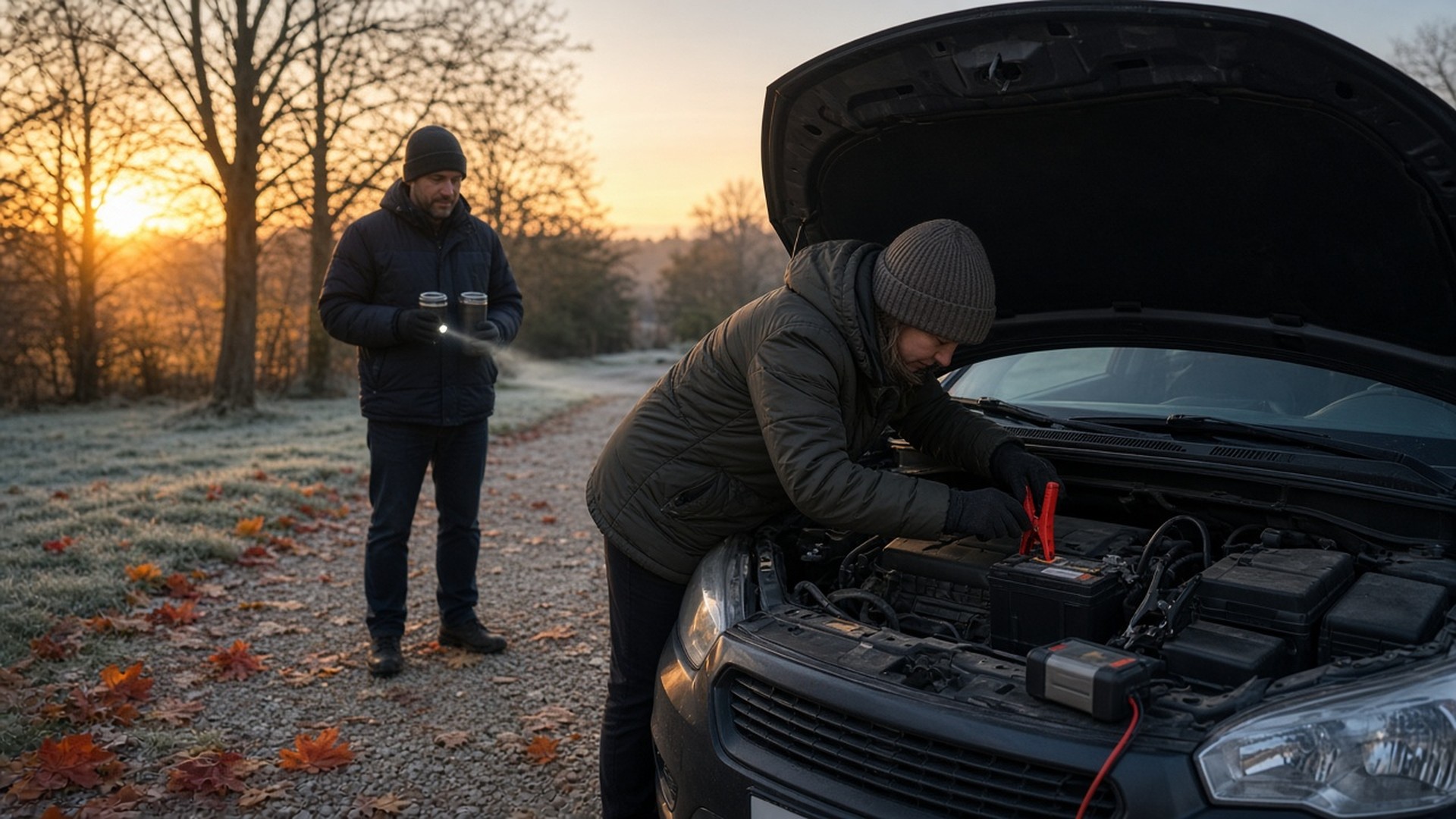
Every fall there's one morning when the temperature drops overnight, you turn the key, and the car answers with a click instead of an engine. The old fix was to knock on a neighbor's door, find a set of jumper cables, and line two cars up nose to nose. A portable jump starter turns that into a five-minute, one-person job, and the NOCO Boost GB40 is small enough to live in the glovebox all season.
What you're buying
The NOCO Boost GB40 12V 1000A UltraSafe Lithium Jump Starter lists at $99.95 on the site. Per the product page, it's a portable 12V, 1000-amp lithium jump starter rated to start gas engines up to 6.0 liters and diesel engines up to 3.0 liters. It uses UltraSafe spark-proof clamps, has a built-in LED light, supports USB charging, and is described as compact and rechargeable, built for roadside emergencies and travel. Catalog rating: 4.3 / 5.0.
Why it beats jumper cables
You don't need a second car. Cables only work if someone else shows up, parks close enough, and knows the order to connect things. A jump starter carries its own power, so the empty office lot at 7 p.m. or the trailhead with no one around stops being a problem.
The clamps are designed to be forgiving. The listing calls out spark-proof clamps, which matters when you're doing this half-awake in the cold. You should still follow the manual and match red to positive and black to negative, but it's reassuring gear for someone who doesn't jump cars often.
It's a light, too. Dead batteries rarely happen in good light. A built-in LED means you aren't holding a phone flashlight in your teeth while you look for the battery terminals.
Check your engine size first
Before you buy, look up your engine displacement in the owner's manual or on the registration. The GB40 is rated for gas engines up to 6.0L and diesels up to 3.0L per the product page, which covers most sedans, crossovers, and many SUVs and pickups. If you drive a large diesel truck or something with an unusually big engine, check NOCO's sizing guidance before you rely on it.
How we'd set it up for the season
Charge it the day it arrives. Then put a recurring reminder on your phone to top it off every couple of months, and again before a long holiday drive. A jump starter only helps if it has power when your battery doesn't.
Read the manual once at home. Ten minutes on a sunny afternoon, with the hood open, so you know where your battery terminals are and how the unit signals that it's ready. That's a lot easier than learning in a dark parking garage.
Give it a fixed spot. Glovebox, center console, or a small bag in the trunk with a pair of gloves. Everyone who drives the car should know where it lives.
After a jump, keep driving. Give the alternator a chance to put some charge back into the battery, and if it happens twice in a short stretch, get the battery tested. A jump starter gets you going; it doesn't fix a battery that's at the end of its life.
Who this is for
Commuters who park outside, college students driving older cars, anyone with a car that sits for a week at a time, and road-trippers heading out for the holidays. It also makes a genuinely useful gift for a new driver. Skip it if you already carry a jump starter that holds a charge, or if your vehicle's engine is beyond the rated sizes above.
What we're not claiming
We didn't jump a car with this unit, measure its output, or test how long it holds a charge in cold weather. The price, 12V 1000A rating, gas and diesel engine limits, UltraSafe spark-proof clamps, built-in LED light, USB charging, compact rechargeable design, and rating above come from the product page and catalog. Charge it, stash it, and let the first cold snap be somebody else's story.